
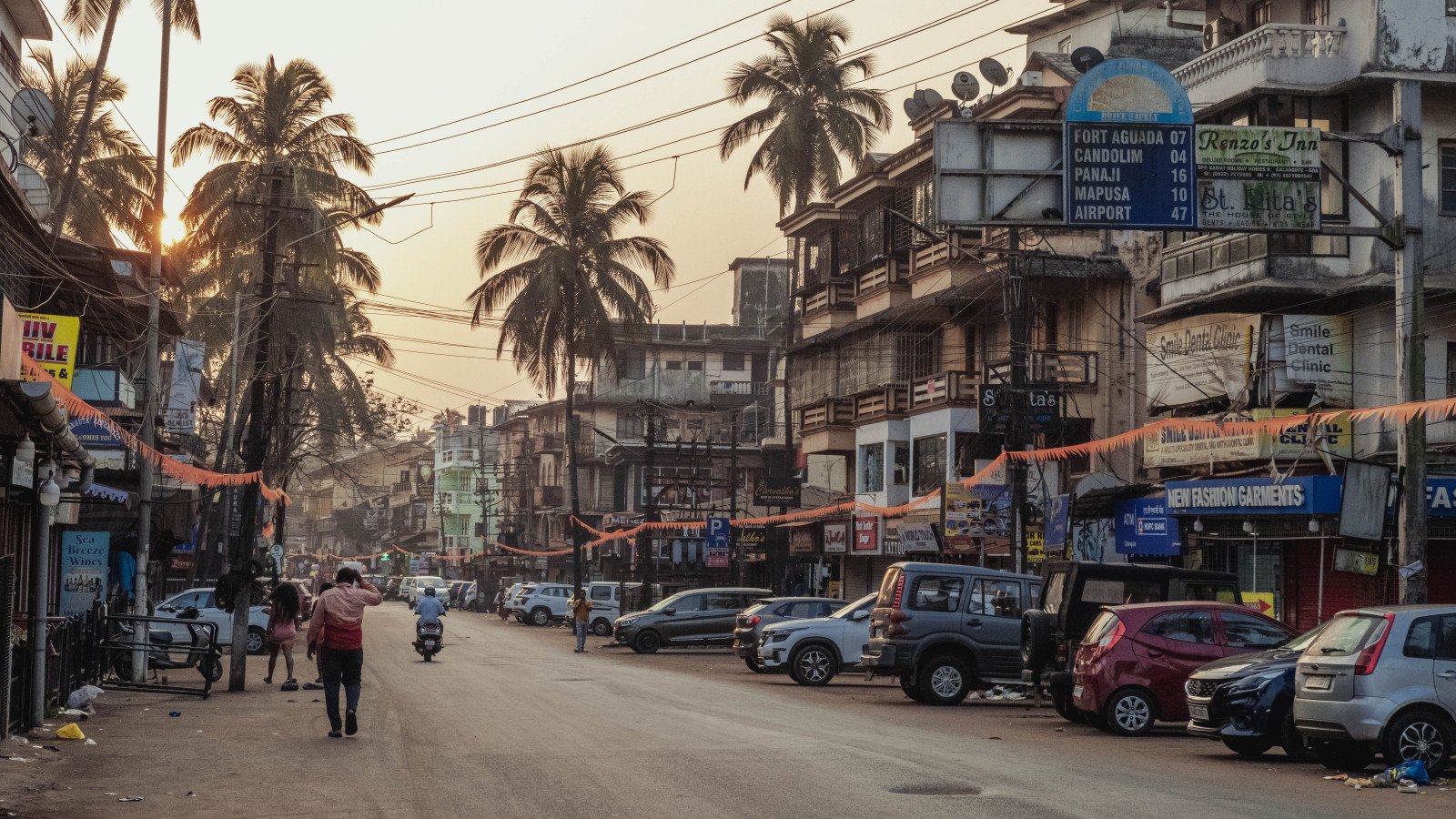
Porvorim, Candolim and Calangute sit within roughly 10-15 km of each other in Goa’s Bardez taluka, but they serve different buyers. Porvorim is an inland, administrative hub next to Panaji suited to year-round end-use living; Candolim and Calangute are coastal tourism belts suited to lifestyle buyers and short-stay rental income, with denser Coastal Regulation Zone (CRZ) exposure and seasonal congestion. No comparison of asking prices alone should decide between them — CRZ classification, land-title type and the buyer’s actual use case matter more than the headline per-square-foot number.
PropIntel is a boutique real estate advisory covering Goa’s second-home, villa and apartment market alongside Delhi-NCR, Gurugram and senior-living transactions. Bardez taluka, North Goa’s most developed coastal belt, runs from the Panaji-adjacent inland town of Porvorim out to the beach villages of Candolim and Calangute, with Mapusa functioning as the area’s main market and transport town and Reis Magos as a quieter, heritage riverside pocket near the 17th-century fort of the same name. This article compares Porvorim, Candolim and Calangute directly on connectivity, pricing signals, CRZ and title risk, and buyer suitability, building on PropIntel’s earlier coverage of North Goa’s quieter inland villages and the North-vs-South Goa decision.
Key Takeaways
- Porvorim is an inland, non-tourist administrative and residential hub a short drive from Panaji; Candolim and Calangute are dense coastal tourism belts with meaningfully higher footfall and seasonal traffic.
- Portal-listed asking prices in October 2026 put Candolim and Calangute well above Porvorim on a per-square-foot basis, but the two property portals PropIntel checked gave internally inconsistent figures for the same locality — treat any such number as directional only, not a transacted benchmark.
- Candolim faced an active Coastal Regulation Zone compliance challenge before the Bombay High Court’s Goa bench in July 2026, a reminder that CRZ due diligence applies to prominent, well-resourced projects, not only budget construction.
- North Goa’s premium residential segment is reported to have softened 4-6 per cent in the first half of 2026 — general market context, not a locality-specific figure for Porvorim, Candolim or Calangute individually.
- This comparison covers the denser coastal-and-inland belt; PropIntel’s earlier Assagao-Siolim-Anjuna guide covers North Goa’s quieter, boutique-village alternative for buyers who find Candolim or Calangute too commercial.
Porvorim, Candolim and Calangute: Three Different Goa Living Experiences
Porvorim: The Administrative Hub Next Door to Panaji
Porvorim sits just across the Mandovi River from Panaji, connected by the Atal Setu and the older Mandovi bridge, and functions as Goa’s de facto secondary administrative and commercial hub — home to government offices, hospitals, schools and a growing stock of mid-rise apartments. It carries little tourist footfall, which suits buyers who want Goa as a place to live and work rather than a seasonal destination, and its civic infrastructure tends to track Panaji’s urban planning more closely than the informally developed coastal villages.
Candolim: Upscale Beach Belt With Dense Tourism Infrastructure
Candolim runs along the coast north of the Nerul and Sinquerim rivers and has developed into one of North Goa’s more upscale beach addresses, with a concentration of restaurants, resorts and villa developments near Fort Aguada. That same coastal proximity means a larger share of plots fall within CRZ categories carrying construction restrictions and no-development setbacks from the high-tide line.
Calangute: Goa’s Busiest Beach Commercial Belt
Calangute, long marketed as the “Queen of Beaches,” is the most commercially developed and crowded of the three during the October-to-March season, with the highest density of shacks, markets and short-stay accommodation. This supports strong short-term rental demand but brings the most seasonal noise, traffic and parking pressure of the three — expect a materially different experience in peak season versus the monsoon off-season.
Mapusa and Reis Magos: The Reference Points Nearby
Mapusa, a few kilometres inland, is North Goa’s principal market town and transport interchange — relevant to buyers in all three locations for everyday shopping and bus connectivity. Reis Magos, on the riverside near its historic fort, is a smaller, quieter pocket with limited inventory, appealing to buyers who like Candolim’s coastal character but want less density.

Conscient Asaya — Goa — Branded Development
Speak directly with Kshitiz Verma, Principal Partner, about this mandate.
Branded villa development in North Goa. Ask for current inventory and pricing.
Price Signals: What the Portals Show, and Why to Treat Them Cautiously
PropIntel checked listed average asking prices for all three localities in October 2026. The figures below are seller asking prices from a property portal, not transacted sale values, and the portal itself published inconsistent headline and FAQ figures for the same locality — a limitation worth stating plainly rather than papering over.
| Locality | Portal-listed asking price range (per sq ft, Oct 2026) | Reported 1-year change | Caveat |
|---|---|---|---|
| Porvorim | Roughly ₹8,000–₹13,000, with outlier listings as low as ₹1,500 and as high as ₹24,000 | Portal showed two different figures: +8.5% and +13.6% | Wide range reflects a mix of older apartment stock and new mid-rise launches |
| Candolim | Roughly ₹13,000–₹18,000, with listings from ₹8,800 to ₹29,000 | Portal showed two different figures: -8.7% and -9.4% (both declines) | Premium villa listings sit well above apartment listings in the same locality |
| Calangute | Roughly ₹12,600–₹14,400, with listings from ₹4,500 to ₹27,900 | Portal showed two different figures: +5.7% and +7.2% | Includes both small tourist-let units and larger standalone villas |
Figures are portal-listed asking prices accessed on 22 October 2026 and are a directional indicator only — not RERA, government or transacted-value data, and no substitute for an independent valuation. Separately, North Goa’s premium residential segment was reported to have corrected 4-6 per cent in H1 2026 after several years of sharp growth — useful belt-wide context, though not broken out by individual locality in the reporting PropIntel reviewed.
CRZ and Land-Title Risk: What to Verify Before Candolim or Calangute
Coastal Regulation Zone rules restrict construction based on a plot’s distance from the high-tide line, with CRZ-III no-development zones carrying the tightest limits. In July 2026, a residential villa project in Candolim near the Sinquerim river became the subject of a Public Interest Litigation before the Bombay High Court’s Goa bench, with the petition alleging the project fell within a CRZ-III no-development zone and challenging an occupancy certificate the local panchayat had issued. The court’s notice is not a finding of wrongdoing, and the matter remains pending — but it illustrates that CRZ compliance questions can reach even large, professionally executed coastal projects, not only informal construction. Porvorim, being inland, carries materially less CRZ exposure than Candolim or Calangute, which is one of the clearer structural differences between the two groups of localities.
Separately, Goa’s historical comunidade land-tenure system means not every plot carries straightforward freehold title; PropIntel’s earlier Goa title-verification guide sets out the document chain — sanad, comunidade records, encumbrance certificate — that applies regardless of which of these three localities a buyer chooses.
Connectivity and Everyday Living
Porvorim’s position next to Panaji gives it easier, less seasonal access to government offices, hospitals and established schools, and it avoids the peak-season congestion on the coastal road network. Candolim and Calangute depend more heavily on that coastal corridor, considerably busier between December and February. Buyers prioritising a quiet, walkable daily routine over beach proximity generally find Porvorim the easier fit; buyers who want to be minutes from the sand accept Candolim’s or Calangute’s seasonal trade-offs in exchange.
Buyer-Suitability Comparison
| Criterion | Porvorim | Candolim | Calangute |
|---|---|---|---|
| Primary character | Inland administrative/residential hub | Upscale coastal tourism belt | Dense commercial beach belt |
| CRZ exposure | Low (inland) | Moderate to high (coastal) | Moderate to high (coastal) |
| Seasonal congestion | Low | Moderate | High (Oct–Mar) |
| Short-stay rental demand | Limited | Strong | Strongest of the three |
| Best suited for | Year-round residents, retirees, professionals | Lifestyle second-home buyers | Rental-income-focused buyers comfortable with density |
Due-Diligence Checklist Before Buying in Any of These Micro-Markets
- Confirm the exact plot’s CRZ classification directly with the Goa Coastal Zone Management Authority rather than relying on the locality’s general reputation.
- Establish whether the land is comunidade-held, comunidade-converted freehold, or private freehold, and verify the full title chain, including the sanad and encumbrance certificate.
- Compare the sanctioned building plan against the as-built structure; deviations between the two are a recurring, documented issue in Goa’s coastal belt.
- For rental-income buyers, check current local rules on homestay and short-term-rental registration before assuming a unit can be let commercially.
- Treat portal asking prices as a starting point for negotiation, not a transacted comparable, and commission an independent valuation for any serious offer.
- Confirm North Goa Planning and Development Authority or panchayat approvals specific to the plot, especially for any project still under construction.
Who Each Micro-Market Suits — and Who Should Look Elsewhere
Porvorim suits buyers who want Goa as a genuine year-round base — professionals commuting into Panaji, retirees prioritising hospital and civic access, and families weighing school options — more than buyers chasing a beachfront lifestyle. Candolim suits buyers who want an upscale coastal second home and are prepared to manage CRZ and title verification carefully. Calangute suits buyers principally focused on short-stay rental income who are comfortable with the highest seasonal density of the three. Buyers seeking total seclusion rather than any of these three profiles may be better served by the quieter villages covered in PropIntel’s Assagao-Siolim-Anjuna comparison, and buyers uncomfortable with CRZ or comunidade title complexity in any coastal locality should treat that discomfort as a reason to slow down, not a reason to skip verification.
Frequently Asked Questions
Is Candolim or Calangute better for rental income in Goa?
Calangute generally sees stronger short-stay tourist demand given its commercial beach-belt character, though Candolim’s more upscale positioning can support higher nightly rates for fewer bookings. Actual returns depend heavily on the specific property, management arrangement and local rental registration compliance.
Is Porvorim a good place to buy property in Goa?
Porvorim suits buyers prioritising year-round, non-seasonal living with easier access to Panaji’s civic and medical infrastructure, rather than beachfront lifestyle or short-stay rental income, which are limited here compared with the coastal belt.
Are Candolim and Calangute properties affected by CRZ rules?
Yes. Both sit within Goa’s coastal belt and include plots in CRZ-II and CRZ-III classifications that restrict construction based on distance from the high-tide line. A July 2026 Bombay High Court case involving a Candolim project illustrates that this applies even to substantial, professionally developed projects, and any specific plot’s classification should be verified independently.
What is the difference between Porvorim and Panaji for property buyers?
Porvorim is a separate town across the Mandovi River from Panaji city, generally offering comparatively lower prices and more recent mid-rise development, while remaining close enough for daily commuting into Panaji for work, healthcare and administration.
Should NRIs buy in Candolim or Calangute, or a quieter village like Assagao?
That depends on intent. Candolim and Calangute suit NRIs wanting a lifestyle second home with tourist-belt amenities and rental potential; Assagao, Siolim and similar inland villages, covered in PropIntel’s separate comparison, suit NRIs prioritising seclusion and a boutique, lower-density character over beach proximity.
PropIntel Perspective
The real choice among Porvorim, Candolim and Calangute is less about price and more about what the buyer wants Goa to be: a daily-life base, a seasonal retreat, or a rental-income asset. Porvorim trades beach proximity for lower CRZ exposure and steadier civic infrastructure; Candolim and Calangute trade that stability for lifestyle appeal and rental demand, at the cost of denser regulatory and seasonal complexity. The 2026 CRZ litigation touching a Candolim project is a useful reminder that coastal due diligence is not a formality even for substantial developments. Buyers who cannot get a straight answer on a plot’s CRZ classification or title chain would do well to wait rather than proceed on asking-price comparisons alone. This is general information, not investment advice, and not a projection of future rental yield or appreciation.
Sources and Methodology
Information reviewed on: 22 October 2026. Price-trend figures were accessed from Housing.com’s Porvorim, Candolim and Calangute locality pages on 22 October 2026 and are explicitly flagged above as internally inconsistent portal data, not transacted values. The Candolim CRZ litigation is reported by Business Today (8 July 2026). The North Goa premium-price correction figure is reported by Construction World and The Daily Pioneer. CRZ classification guidance should always be confirmed directly with the Goa Coastal Zone Management Authority for any specific plot. Recommended review: within 90 days, or sooner if the Candolim CRZ case produces a substantive ruling.
Author: PropIntel Research Desk, in consultation with PropIntel’s Goa advisory team. Reviewed for regulatory accuracy by PropIntel’s due-diligence lead. Published 22 October 2026; last reviewed 22 October 2026. This article is general information, not legal, tax or investment advice. Readers should obtain project-specific legal and financial advice and verify CRZ and title status independently before completing any Goa property transaction.
Related PropIntel Reading
- North Goa vs South Goa: Which Suits Your Property Investment in 2026?
- Assagao vs Siolim vs Anjuna: Choosing the Right North Goa Village for Your Second Home
- How to Verify Property Title Before Buying in Goa: A 2026 Checklist
- Is a Goa Holiday Home Still a Good Rental-Income Bet in 2026?
- Goa Real Estate 2026: Why Big Developers Are Entering the Market
For an independent view on choosing between North Goa micro-markets for your specific use case, speak with PropIntel’s advisory team.